Dietary Filter • Concept 2026
A Google Maps filter that finds food safe for your diet
- Role
- Product Designer, UX Researcher, Design Systems
- Timeline
- April 2026 to July 2026 (class quarter, then a solo three-week v2)
- Team
- Mason Oelschlager, Asher Hardy, Rayleen Marquez
- Tools
- Figma, Figma Variables & Components, Material Design 3, FigJam, Claude Design
- Live
- Concept
- Second-round testers with real allergies, halal and keto diets
- 5
- High-fidelity directions tested into one hybrid
- 2 → 1
- Of Google listings that fill in any allergen field at all
- 13%
A dietary filter for Google Maps, for people with food allergies. My class team designed it, then I kept going alone for three weeks. It's a Figma concept, not a shipped app.
My interviews found the hard part is social. People hide their allergy so they won't be a burden.
Problem
For someone with an allergy, picking a restaurant is homework done outside Maps.
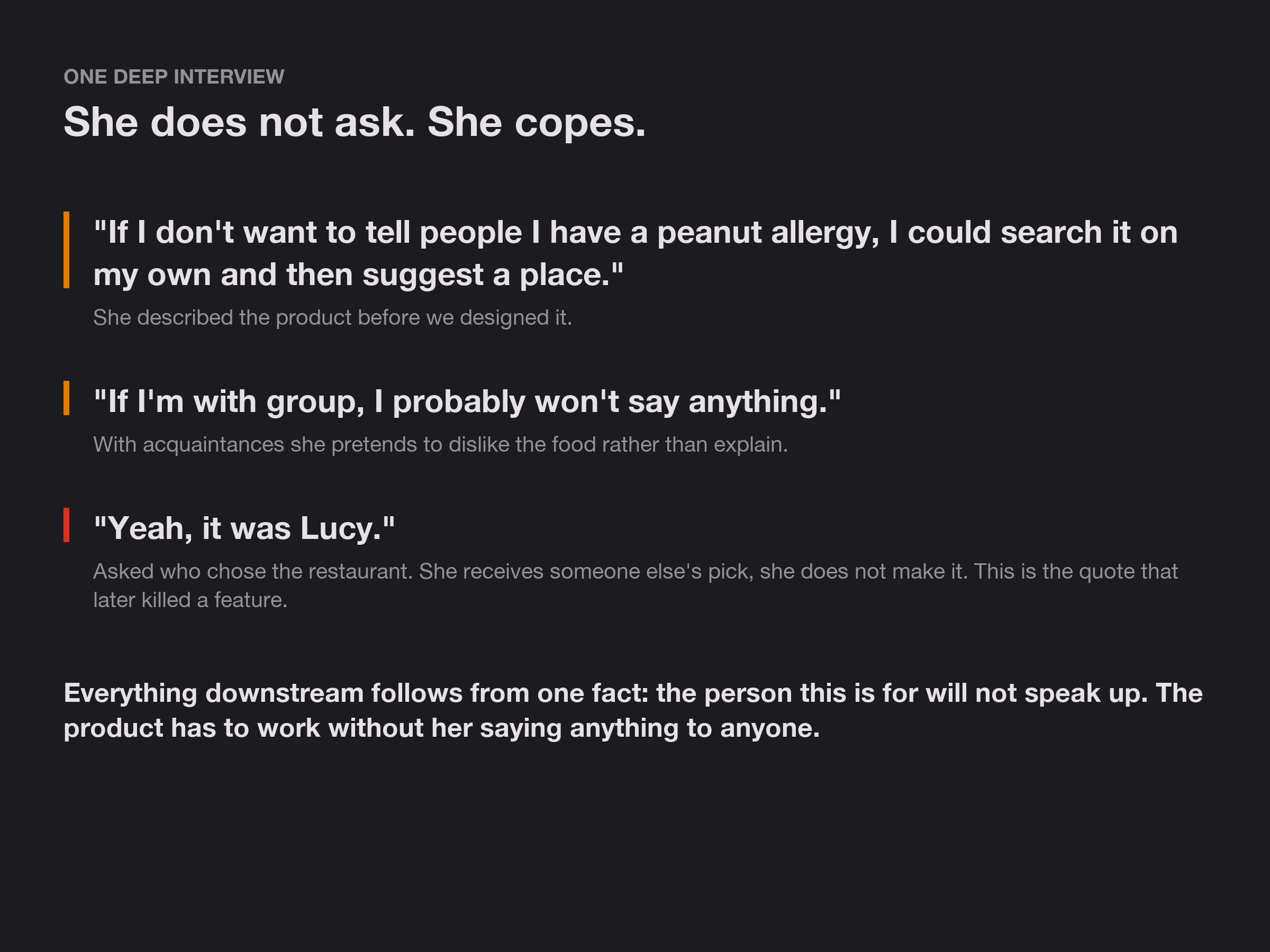
One woman I interviewed checks an allergy site, then Reddit, then Google reviews before any new place. None of it happens in Maps.
She has a serious peanut allergy and eats out in groups. She's the only one tracking what's safe.
Process
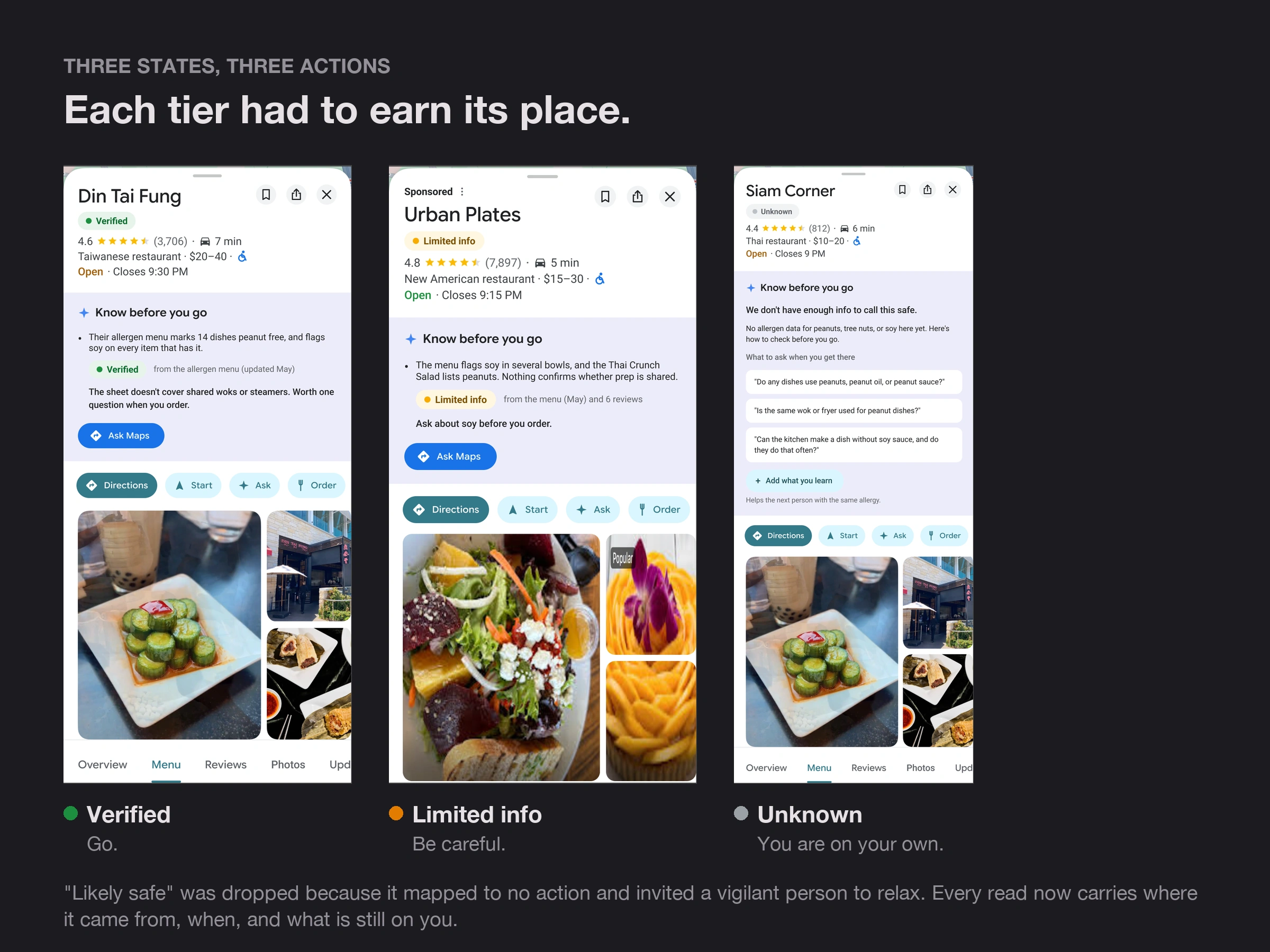
"Likely safe" was the most dangerous thing I designed.
The class version had a state called "Likely safe." It tested well. But for someone always on guard, a soft green light says relax. That's how mistakes happen.
So I made three states, each with its own action. Verified means go. Limited info means be careful. Unknown means you're on your own. The rule: clear slowly, warn quickly.
Process
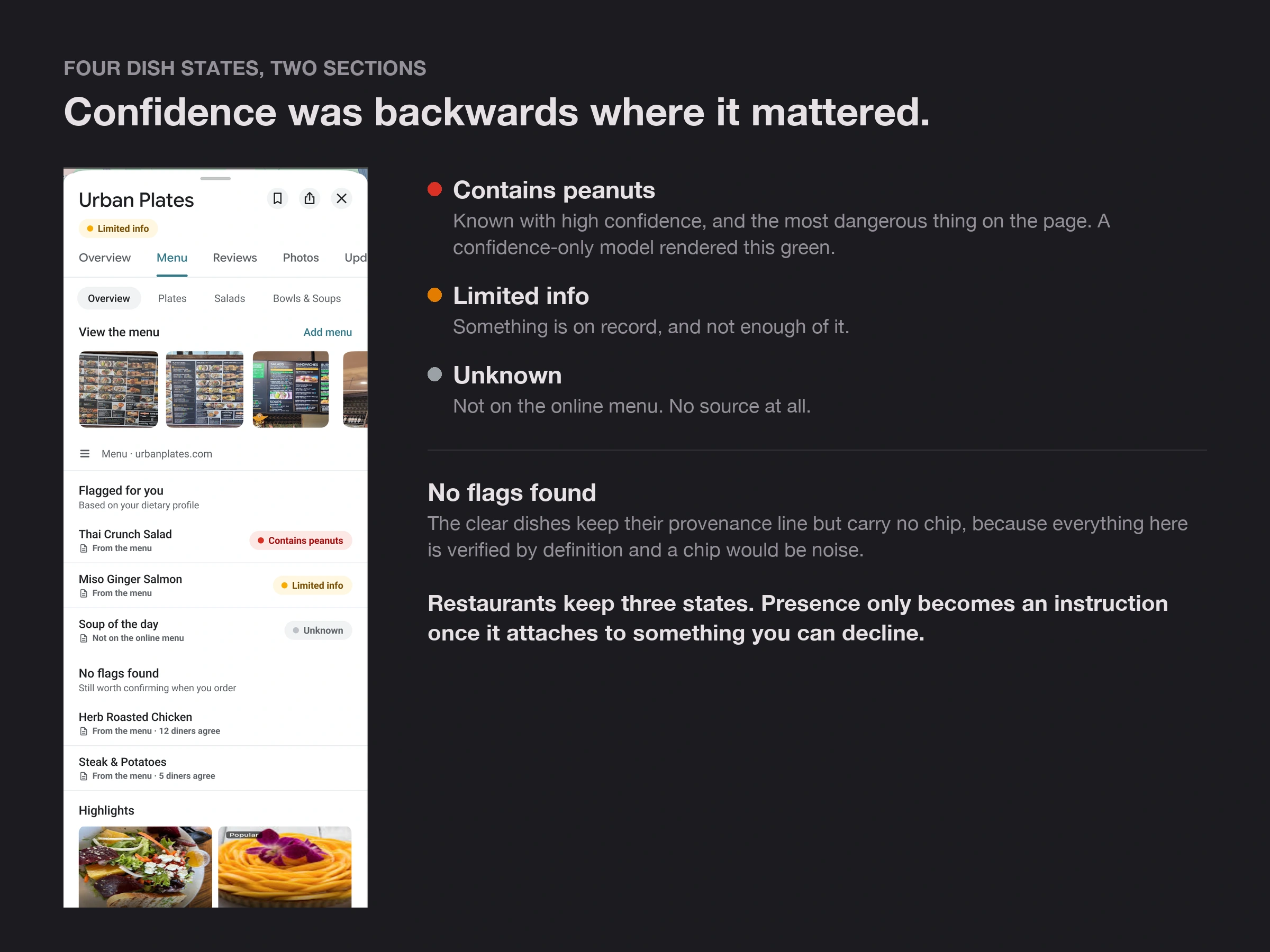
My model called peanut Pad Thai Verified, so dishes got a Contains state.
Pad Thai that lists peanuts is fully known and fully dangerous. My model only measured how much we knew. So it showed a green Verified chip. Exactly backwards.
So dishes got a fourth state, in red: "Contains peanuts."
Process
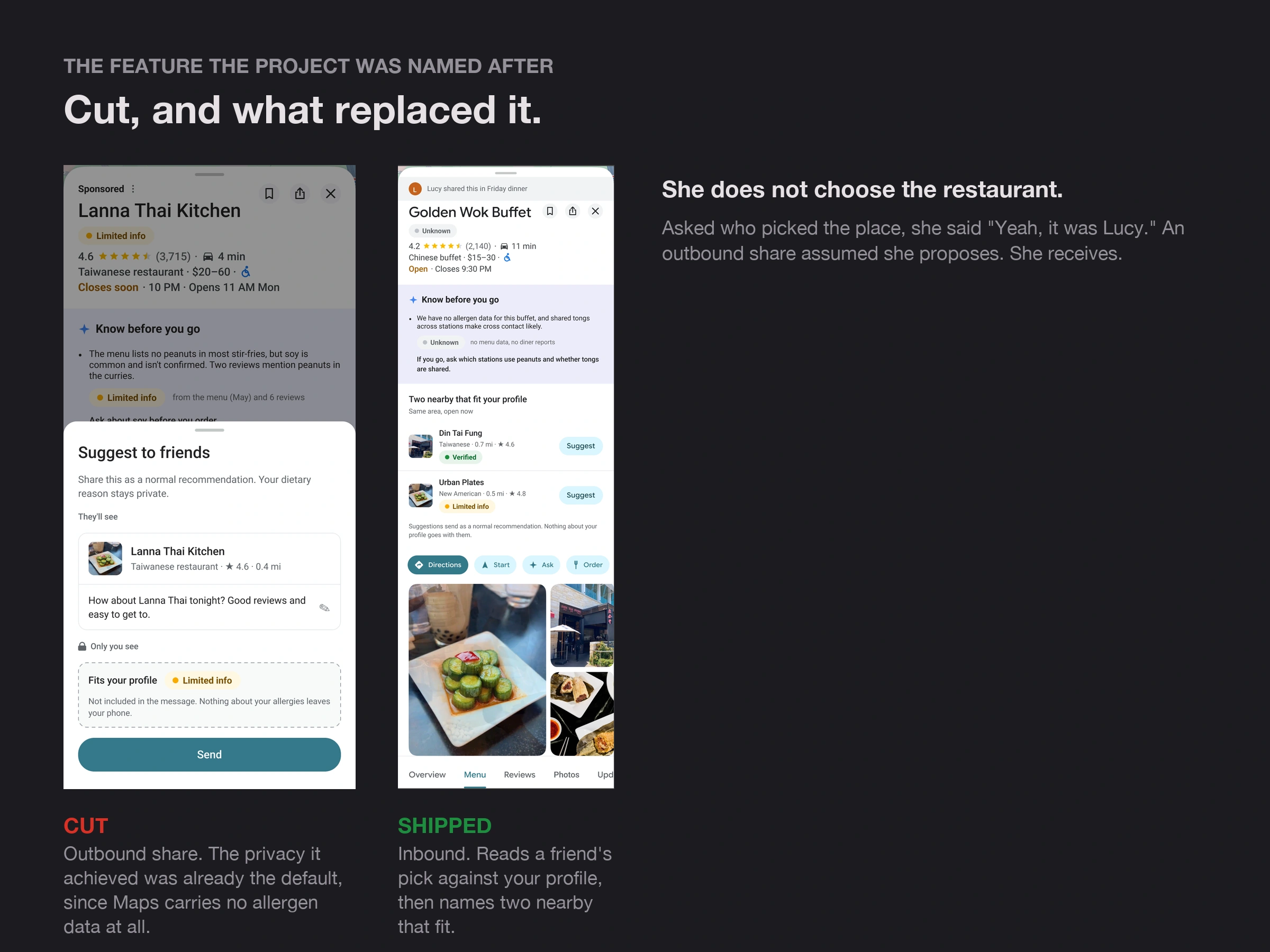
I cut the signature feature because my participant doesn't pick the restaurant.
The class version let you share a place without saying why. But a normal Maps share already says nothing about allergies. And she doesn't pick the place: "Yeah, it was Lucy."
So I flipped it. When a friend shares a place, the app checks it against your profile. If it doesn't work, it names two nearby places that do.
Final Design
Three states for a restaurant, four for a dish, one profile behind both.
You set your profile once, even partial limits. Then every place and dish in Maps reads against it. None of it tells the group why.
Reflection
Still a Figma concept. Next, I'd ask someone with an allergy if it's true.
The hardest part isn't the screens. US restaurants don't have to list allergens, and most Google listings don't.
I haven't tested the trust model with anyone yet. That's the next thing.